
Agentic AI and the 40% Rule: Turning Experiments into Enterprise Decisions
Agentic AI Adoption Accelerates in 2026
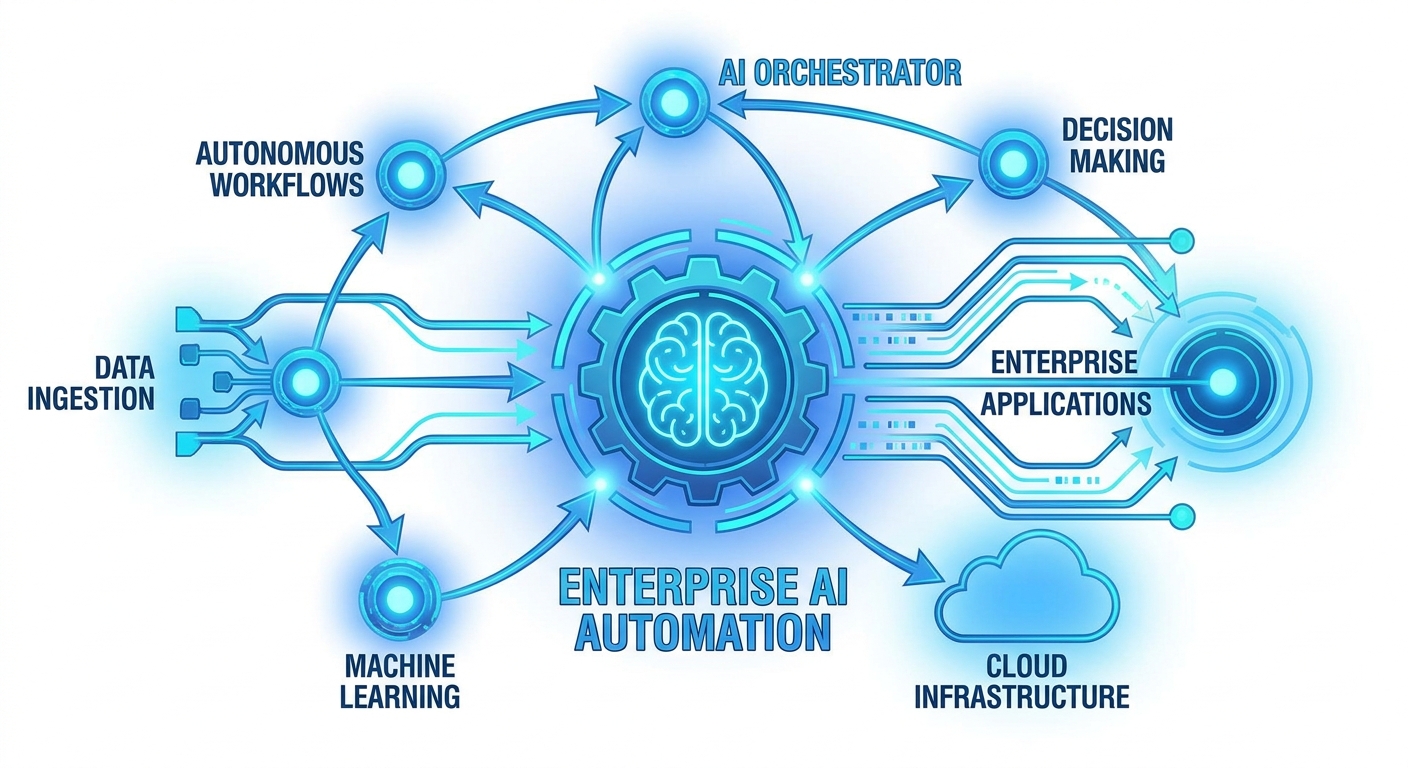
Agentic AI adoption is accelerating across enterprises. Research firms project that autonomous agents will enhance capabilities in over 40% of enterprise applications by 2027, up from less than 5% in 2025.[1][2] Organizations are moving beyond experimental chatbots to deploy agents that execute workflows, make decisions, and manage operations at scale.
For two years, we've been treating AI as a conversational assistant: something you chat with for summaries, drafts, or code snippets. But the next phase isn't about generating content. It's about executing workflows. The question is no longer "What can AI write?" — it's "What processes should AI run without us touching them?"
The gap between these two modes — from conversational to agentic — is where most enterprises are failing. They're building chatbots that look like agents but lack the autonomy, orchestration, and governance to actually do anything meaningful at scale.
Why 40% Matters (and Why 60% Will Struggle)
The organizations reaching 40% adoption understand that agents must be treated as infrastructure, not one-off projects. They've figured out how to move beyond pilots and scale real capabilities.
Successful agentic deployments in 2026 share three characteristics:
1. They Started Small, But Thought Big
The organizations succeeding with agents didn't try to automate everything at once. They started with a single, well-defined workflow: cloud cost optimization, ticket routing, lead qualification, compliance checks. The agent executes that one thing autonomously, with clear guardrails and measurable outcomes.
Only after establishing trust through consistent performance do they expand to adjacent workflows. This is how you get from 1% to 40% without creating a mess.
2. Governance Is Built In, Not Bolted On
More than 40% of agentic AI initiatives could be abandoned by 2027 without proper governance and clear return on investment.[1] The culprits are escalating costs, unclear ROI, and inadequate risk controls.
The difference between survivors and failures isn't technology — it's governance architecture. Successful deployments have:
- Explainable decision trails — Every agent action can be traced back to its reasoning
- Automated audit logs — Complete records of inputs, outputs, and decisions for compliance
- Real-time guardrails — Hard limits on what an agent can do, with human oversight for edge cases
- Cost visibility — Clear understanding of inference costs per workflow, per decision
Managing AI agents at scale requires an operational layer responsible for monitoring cost, reliability, and compliance across your enterprise — a discipline sometimes called AgentOps.[1]
3. Multi-Agent Systems, Not Solo Performers
The most sophisticated agent deployments in 2026 aren't single autonomous systems — they're orchestrated collectives where specialized agents collaborate.
Think of it like a team: one agent handles data retrieval, another validates decisions, a third manages communication with external systems, and a supervisor agent monitors for anomalies or policy violations. This architecture provides both the specialization needed for complex workflows and the redundancy needed for reliability.
The Real Cost Challenge
A key challenge is exploding inference costs. Agentic AI requires continuous operation with multiple inference calls — agents break tasks into sub-steps, iterate toward goals, validate outputs, and often run multiple attempts before succeeding.
The organizations that see ROI from agents aren't using them for everything. They're being surgical:
- High-volume, repetitive decisions → agent automation delivers clear ROI
- Complex analysis requiring iteration → agents excel at exploring options humans would skip
- Time-sensitive workflows → autonomous response beats human latency
- Low-risk exploratory work → let agents iterate on ideas before humans validate
The ones failing are treating agents like magic wands: "Let's automate all of this" without quantifying either the cost of automation or the value it creates.
Where Agents Actually Win (According to 2026 Deployments)
Cloud Cost Optimization
Continuous monitoring, resource rebalancing, and policy enforcement across cloud infrastructure is one of the most immediate ROI cases because savings are visible and continuous.[1]
Software Delivery
Agents that can review code, run tests, identify security issues, and deploy to staging or production environments based on predefined criteria reduce deployment friction and accelerate feedback loops.
Customer Support Tier-2
Agents are now handling resolution tasks: accessing order history, processing refunds, updating records, and coordinating with fulfillment teams — all without human intervention.[1] This saves support teams 40+ hours monthly.[1]
Research & Knowledge Synthesis
Agents that can search across your documentation, databases, and knowledge bases, synthesize findings, and produce structured summaries for human review turn hours of manual research into minutes.
What Failing Looks Like
The failure patterns from the 40% of projects that could be abandoned:
- Scope creep without metrics — expanding agent capabilities faster than you can measure outcomes
- Underestimated cost — not accounting for iterative search, multiple attempts, and complex reasoning workflows
- No governance framework — agents making decisions in production with unclear audit trails
- Integration debt — building agents that can't actually reach the systems they need to affect change
The common thread? Starting with "cool technology" instead of "clear business problem."
The Human Role Is Evolving, Not Disappearing
Successful agentic AI deployments don't eliminate humans — they redefine their role.[1] Employees need training in how to design agent workflows, supervise their operation, and collaborate effectively with automated systems.[1] New roles are emerging: agent architects, performance engineers, and oversight specialists.
Employees become overseers of agent operations, handling exceptions, setting strategic direction, and making judgment calls when the system flags edge cases. The workflow shifts from execution to oversight.
Your Path Forward
Phase 1: Identify High-ROI Workflows (Months 1-2)
Audit your processes for repetitive, high-volume decisions. Look for cases where:
- The decision criteria are clear and codifiable
- Errors have low or bounded consequences
- The time saved per execution matters at scale
Start with one workflow you can measure rigorously.
Phase 2: Build Governance First (Months 2-3)
Before deploying any agent, establish:
- What decisions the agent can make autonomously vs. requiring approval
- How to audit every action for compliance
- Cost monitoring and alerting thresholds
- Escalation paths for edge cases or failures
This governance layer becomes your operational infrastructure.
Phase 3: Start Single-Agent, Scale to Multi-Agent (Months 3-6)
Deploy your first agent in production with narrow scope but high reliability. Once you've proven the pattern and built trust with stakeholders, begin architecting multi-agent systems where specialized agents collaborate on more complex workflows.
Phase 4: Build Your Own Agent Capability (Months 6+)
The organizations that scale fastest don't rely entirely on vendors. They develop internal capability in agent orchestration, governance frameworks, and deployment patterns. This becomes a differentiator — your proprietary knowledge embedded in autonomous systems.
The Window Is Opening (and Closing)
Enterprises that deploy agentic AI this year will gain operational advantages from autonomous decision-making at scale, orchestrated workflows that previously required teams of people, and efficiency gains their competitors can't easily replicate.
The organizations that wait will find themselves playing catch-up with infrastructure to rebuild — governance models they could have started building today, operational practices they're now scrambling to implement, and the trust gap between IT and business that takes years to close.
At Pii Data Science, we help organizations design and deploy agentic AI systems that deliver real ROI without sacrificing governance or control. From initial workflow identification through multi-agent orchestration and operational infrastructure, we build the autonomous decision engines that differentiate market leaders. If you're serious about positioning your enterprise for the next wave of AI — let's talk.
Sources
[1] Joget — "AI Agent Adoption 2026: What the Data Shows" — https://joget.com/ai-agent-adoption-in-2026-what-the-analysts-data-shows/
[2] Itential — "Gartner Predicts 2026: AI Agents Will Reshape Infrastructure Operations" — https://www.itential.com/resource/analyst-report/gartner-predicts-2026-ai-agents-will-reshape-infrastructure-operations/