
The Execution Gap: Why 65% of AI Projects Die Before Production
The Numbers Don't Lie
Deloitte's State of AI 2026 report shows a significant gap between adoption and production scaling. Workforce access to sanctioned AI tools has grown by 50% in one year—moving from under 40% to around 60%—yet only 25% of organizations have moved 40% or more of their AI experiments into production[1]. That gap between pilots and production deployments represents the core challenge facing enterprises today.
Most enterprises remain early in operationalization. They've proven AI works in controlled environments. They struggle to deploy it at scale in their business.
Why Projects Fail
After working with dozens of organizations across biotech, pharma, and enterprise, we've identified the three most common failure modes:
1. The Data Foundation Is Broken
Data quality and infrastructure remain blocking issues. Fragmented data sources, inconsistent schemas, missing governance, and no clear ownership create an unstable foundation. The issue is data infrastructure, not models.
The fix isn't glamorous. It's data engineering, semantic layers, and governance frameworks that standardize how your organization defines and accesses its data. Models built on poor data fail in production.
2. The Talent Gap Is Real
There aren't enough people who can do this work. Not enough data scientists, not enough ML engineers, and critically—not enough people who understand both the science and the business context.
This is where consulting partnerships matter. You don't need to hire a full team to get started. You need experienced practitioners who can stand up your first production system and transfer knowledge to your team.
3. Integration Is Harder Than Modeling
Modeling is easier than integration with enterprise systems. You must integrate AI with your CRM, ERP, data warehouse, and the legacy systems that run core operations.
Production AI requires software engineering alongside data science.
The Path Forward
Start With the Business Problem, Not the Technology
Every successful AI deployment we've been part of started with a clear business question: "How do we reduce patient wait times?" or "Which leads are most likely to convert?" The technology follows the problem.
Invest in Infrastructure Before Models
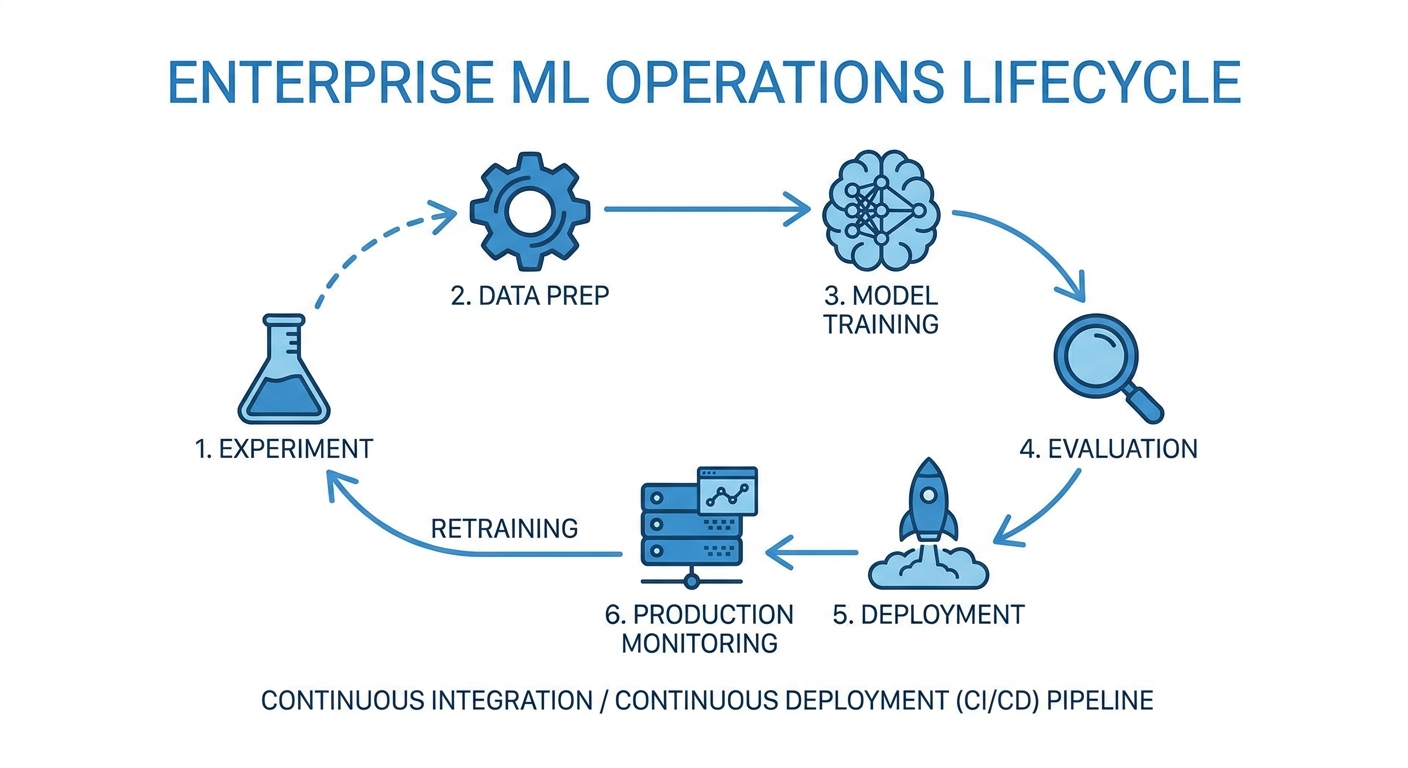
Semantic layers, data pipelines, monitoring, and CI/CD for ML models. This unglamorous work separates production AI from demo AI.
Build for Observability
If you can't explain what your model is doing, you can't trust it. Governance-as-Code is emerging as a standard—embed compliance, monitoring, and explainability directly into your AI workflows.
Partner Strategically
The organizations that scale AI fastest don't try to build everything in-house from day one. They partner with specialized consultancies who've done this before, then progressively build internal capability.
The Opportunity
The gap between adoption and production deployment is bad news for enterprises stuck in pilots. It's excellent news for organizations willing to invest in the fundamentals. Organizations investing in fundamentals can achieve production AI faster.
Success depends on whether your organization can make AI work—in production, at scale, with real users and real data.
At Pii Data Science Solutions, we help organizations close the execution gap. From strategy through production deployment, we turn AI investments into measurable business outcomes.
Sources
[1] Deloitte — "The State of AI in the Enterprise 2026" — https://www.deloitte.com/us/en/what-we-do/capabilities/applied-artificial-intelligence/content/state-of-ai-in-the-enterprise.html