Navigating Patient Outcomes in Modern Healthcare: Where Data Meets Care
The Pressure Is Real
Healthcare organizations face increasing pressure to deliver better patient outcomes — and they're being held accountable for it.
From value-based reimbursement models that tie payment to quality metrics, to patients comparing their care against consumer standards, organizational priorities have shifted toward outcome measurement and patient experience improvement.
But here's the disconnect: while executives are mandating these improvements, clinical teams are drowning in data without clear pathways from insight to action. The question isn't whether you should prioritize patient outcomes — it's how do you operationalize this across a complex healthcare ecosystem?
From Reactive to Proactive: The Data-Driven Transformation
The organizations leading in patient outcomes aren't relying on intuition or retrospective analysis. They've built predictive infrastructure that identifies risk before it becomes crisis.
Predictive Analytics for Early Intervention
Deployments focusing on early intervention concentrate on three areas where it matters most:
- Readmission Risk — Models for 30-day readmission risk prediction with reported sensitivity up to 85% or higher in some studies, though performance varies[1]
- Clinical Deterioration — Real-time monitoring of vital signs, lab trends, and EHR data to flag patients hours before critical events[2][3]
- Chronic Disease Progression — Longitudinal analysis predicting exacerbations in diabetes, heart failure, COPD, enabling timely outpatient intervention
These aren't science projects. They're integrated into clinical workflows with clear action protocols: which nurse gets paged, what order sets trigger, and when to escalate to rapid response.
The Gap Between Metrics and Outcomes
Here's what executive dashboards don't tell you: measuring outcomes is different from improving them. A hospital can have perfect compliance with a quality metric while still delivering suboptimal patient experiences.
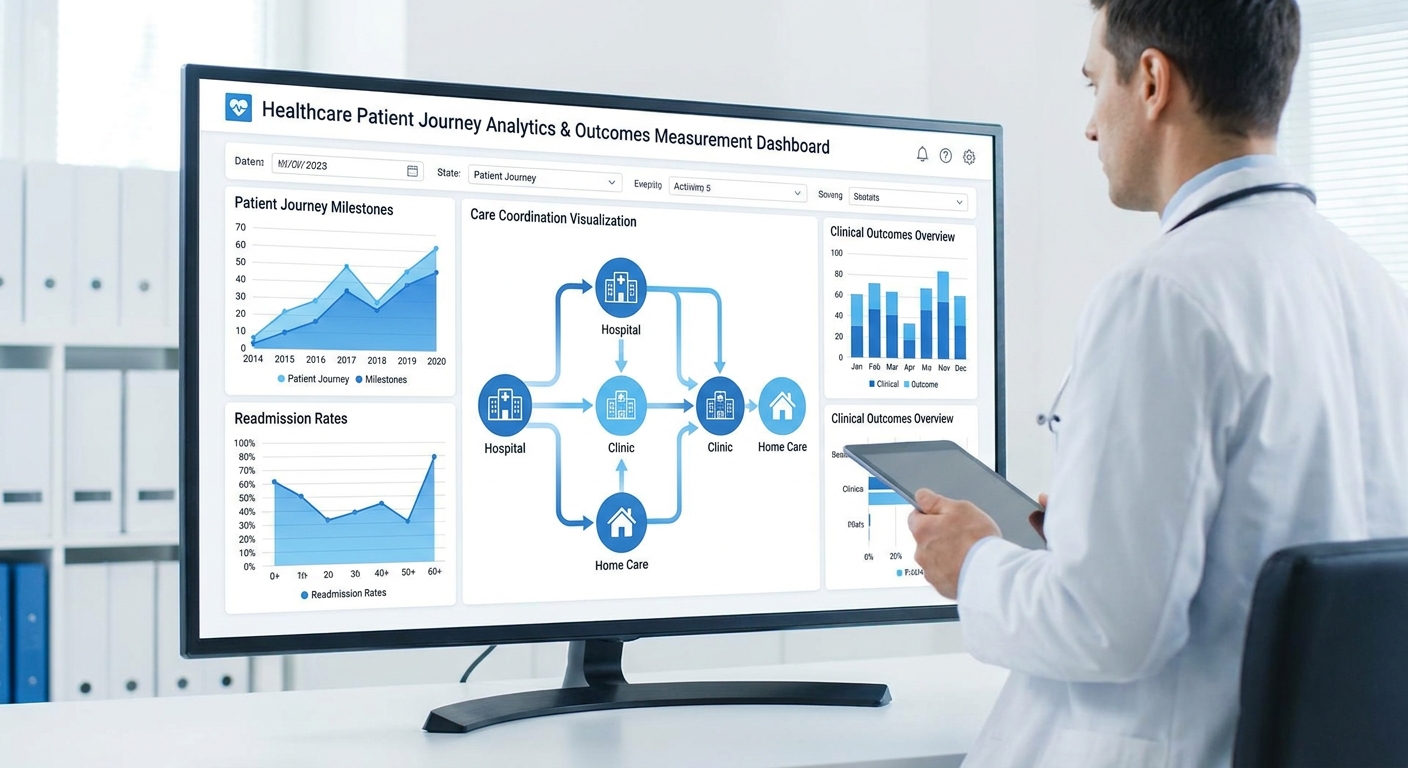
The difference? Organizations that improve outcomes don't just track metrics — they understand the patient journey holistically and use data to identify where interventions will matter most. This requires:
- Mapping every touchpoint from referral to post-discharge
- Identifying handoff points where communication breaks down
- Using patient feedback alongside clinical data
- Testing interventions iteratively, not just monitoring results
Technology as the Enabler — Not the Solution
Technology's role in care coordination is often overstated. The most sophisticated EHR integrations fail when the underlying workflows aren't optimized first. Here's what actually works:
Interoperability That Matters
Patients move through multiple settings of care — primary care, specialists, hospitals, post-acute facilities. Every transition creates information gaps that lead to errors, delays, and poor outcomes.
Successful care coordination technology achieves:
- Unified patient views across all providers and settings
- Real-time status updates (who's admitted where, what medications changed)
- Automated follow-up triggers when patients fall through cracks
- Closed-loop referrals that confirm specialist visits actually happened
Patient Engagement as Clinical Infrastructure
The gap between hospital care and home reality is where outcomes deteriorate. The technologies closing this gap aren't flashy — they're practical:
- Remote patient monitoring for high-risk conditions (hypertension, CHF, diabetes)
- Medication adherence tracking with automated outreach for missed doses
- Symptom reporting portals that feed directly into care team workflows
- Scheduling optimization to reduce missed appointments through predictive timing
Population Health: The Macro View
While individual patient outcomes matter, healthcare systems are increasingly measured on population health management — the collective health outcomes of a defined group. This requires shifting from reactive care delivery to proactive population stewardship.
Risk Stratification at Scale
Effective population health starts with identifying which patients need which level of intervention:
- High-risk, high-need — intensive care management, daily engagement
- Moderate risk — targeted programs for chronic disease management
- Low risk — preventative care, wellness initiatives
The data science challenge? Building models that predict not just medical risk, but also social determinants of health (housing instability, food insecurity, transportation barriers) that drive outcomes as much as clinical factors.
Closing Care Gaps with Precision
Population health management identifies gaps in preventive care, chronic disease management, and specialty referrals. The organizations excelling use data to:
- Predict which patients will miss preventive screenings based on historical patterns
- Personalize outreach — a reminder works for some, a phone call is needed for others
- Measure intervention effectiveness continuously, not annually
- Align incentives between payers and providers with shared metrics
The Human Element: Data Informs, Clinicians Decide
This work isn't about replacing clinical judgment with algorithms. It's about augmenting human expertise with insights that are impossible to synthesize manually.
What Models Handle Better Than Humans
- Pattern recognition across thousands of patients
- Continuous monitoring without fatigue
- Synthesis of heterogeneous data sources (labs, vitals, social determinants)
- Probability estimation for clinical events
What Must Stay Human
- The final decision about care plans
- Patient communication and relationship-building
- Ethical judgment in complex situations
- Understanding individual patient values and preferences
The organizations that succeed build human-in-the-loop systems where AI surfaces insights and alerts, but clinicians remain the decision-makers. Trust is earned when models reduce clinical burden, not add to it.
Implementation: Where Most Organizations Stumble
1. Starting With Technology Instead of Workflows
You can't automate broken processes. Before implementing any predictive model or care coordination tool, map and optimize the underlying workflows. What should happen ideally? Where do we lose patients? What decisions need support?
2. Data Quality as a Prerequisite
Clinical data is messy: incomplete documentation, inconsistent coding, missing timestamps. Models trained on poor quality data fail catastrophically in production. Build data validation and cleaning pipelines before model deployment.
3. Change Management Underestimated
Even the best models will be ignored if clinicians don't trust them or understand how to act on insights. Invest in:
- Clear explanation of what each alert means
- Visible outcomes demonstrating value
- Clinician involvement in design and iteration
- Dedicated champions at each facility
4. Ignoring the Patient Voice
Outcome measurement isn't just clinical metrics. Patient-reported outcome measures (PROMs) capture what matters to patients — quality of life, functional status, satisfaction. These should inform both individual care decisions and population strategies.
The Path Forward for Healthcare Leaders
Immediate Actions (0-90 Days)
- Audit your current outcome measurement capabilities across all service lines
- Identify 2-3 high-impact use cases where you have data quality and workflow readiness
- Engage clinical champions to co-design solutions with data science teams
- Map patient journey touchpoints and identify top drop-off points
Medium-Term (3-12 Months)
- Stand up predictive infrastructure for at least one high-risk condition
- Implement care coordination platform that unifies views across settings
- Build population health segmentation using both clinical and social determinants
- Establish continuous improvement processes for all initiatives
Long-Term (1+ Years)
- Enterprise-wide data infrastructure supporting real-time analytics
- Predictive capabilities across multiple service lines with proven ROI
- Closed-loop measurement linking interventions to improved outcomes
- Culture where data drives decision-making at every level
The Competitive Advantage
Healthcare organizations that master patient outcomes succeed both clinically and economically. Value-based reimbursement is accelerating, patients are more informed and demanding, and competition increasingly hinges on quality metrics rather than price. The gap between organizations optimizing with data and those operating reactively will widen significantly.
Building Outcomes Excellence Together
At Pii Data Science Solutions, we help healthcare organizations transform their approach to patient outcomes — from measurement to improvement. We work alongside clinical teams to:
- Design and deploy predictive models that improve risk stratification, early intervention, and resource allocation
- Build care coordination infrastructure that eliminates information gaps across settings of care
- Implement population health management strategies that close care gaps and improve community outcomes
- Integrate patient-reported outcomes into clinical workflows and quality improvement initiatives
Whether you're building your first outcome optimization program or expanding established capabilities, our expertise spans the full spectrum from data science through clinical implementation. If you're serious about improving patient outcomes in a way that's measurable, sustainable, and truly impactful — let's talk. We'll help you navigate the path forward.
---
Sources
[1] National Institutes of Health — "Readmission Prediction and Clinical Deterioration Detection" — https://www.ncbi.nlm.nih.gov/books/NBK614158/
[2] SR Analytics — "Data Analytics in Healthcare" — https://sranalytics.io/blog/data-analytics-in-healthcare/
[3] Valorem Reply — "Data Analytics in Healthcare" — https://www.valoremreply.com/resources/insights/blog/data-analytics-in-healthcare/