The Operational Intelligence Gap: How Pathology Labs Can Finally Integrate Billing, Testing, and Consumer Data Without Months of Dev Work
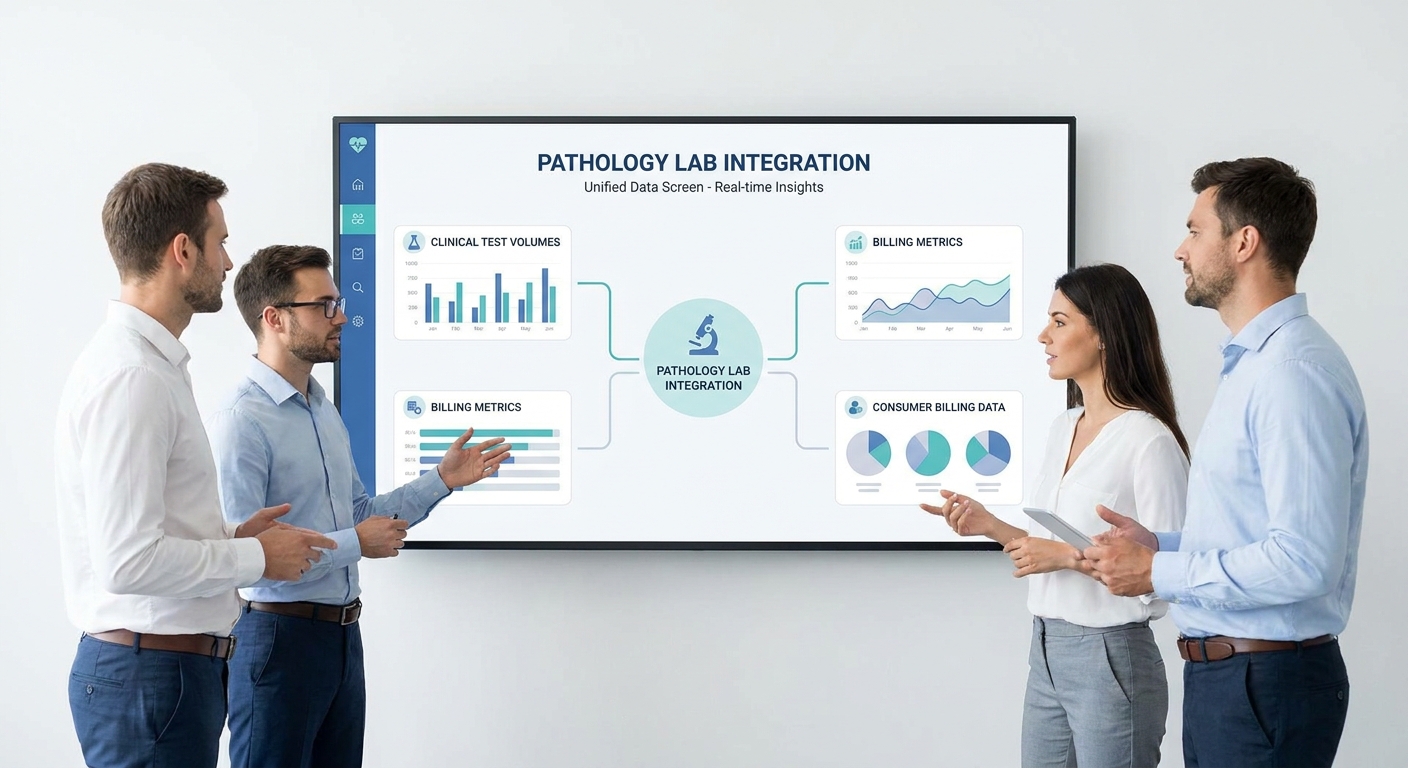
Data Silos in Pathology Labs
Your pathology lab has a data problem. Not a "need better software" problem — a "your entire operational intelligence is trapped in silos" problem.
You run on a Laboratory Information System (LIS) that handles test orders and results. A billing platform that processes claims and manages receivables. A consumer portal where patients pay out-of-pocket. And somewhere, an ERP or spreadsheet system that reconciles the margins. Every system exports data. No system talks to another.
The result? Your operations team spends the majority of their week doing something that feels like work but isn't: manually reconciling data — pulling reports from four systems, normalizing them in a spreadsheet, and building the picture that should have been there automatically.[1]
Clinical Laboratories Operate on Fragmented Data Infrastructure
Clinical laboratories and pathology groups across the country operate on fragmented data infrastructure.[2] Labs run multiple disconnected systems — LIS, billing, consumer portals, ERP — with manual processes bridging the gaps.[1]
The stakes are immediate. When a system like Change Healthcare goes down — as happened in early 2024 — labs experience "substantial billing and cash flow disruptions" with "no outgoing charges or incoming payments for extended periods."[3] The American Hospital Association warned of "immediate adverse impact on hospital finances."[4] This is what happens when your operational intelligence depends on fragile, disconnected systems.
The daily version of this problem is quieter but equally damaging: billing discrepancies go undetected for weeks because there's no unified view.[2] Manual data entry in labs is a widespread but critical risk. Each time a result is typed from an analyzer into a LIMS, then into an EMR, the chance for error doubles. Studies show manual transcription error rates between 3–4%, with some errors significantly altering clinical decisions.[2]
Why Generic AI Tools Fall Short
By now, you've probably tried to fix this with AI. Maybe someone on your team uploaded a billing export to ChatGPT and asked it to "find the anomalies." Maybe a consultant suggested a generic automation tool that was supposed to solve everything.
It didn't work. Here's why:
Generic AI tools — ChatGPT, Claude, Gemini — weren't built for your data. They don't understand CPT codes, ICD-10 modifiers, LIS test result structures, or the specific formats your billing platform exports. You spend more time prompt-engineering and cleaning up hallucinations than you save. And the moment you ask it to work with real patient data, you've got compliance and audit trail problems that didn't exist before.
Labs hold protected health information (PHI) and operate under strict compliance obligations. Generic AI tools have no concept of your data governance requirements, HIPAA compliance, or audit trail obligations. They're black boxes that don't belong in a clinical data environment.
You don't need a chatbot. You need operational intelligence infrastructure — a system that understands your data domain, integrates with your existing systems, and produces structured outputs you can actually act on.[1]
Acme Diagnostics: A Typical Mid-Size Pathology Lab
Let's make this concrete. Acme Diagnostics operates across three locations. They run two different LIS systems — one from their original acquisition, one from a more recent partnership. Their billing runs through a platform that exports monthly reconciliations as CSV files. Patients pay through a consumer portal that sends confirmation emails but doesn't sync back to the billing system. And the ops team manages margins in a spreadsheet that someone updates on Fridays.
The pain points:
- End-of-month reporting requires manual consolidation from multiple systems.
- Billing discrepancies are discovered weeks later — sometimes after patients have been billed incorrectly.
- Consumer billing reconciliation is manual: someone matches portal payments to invoices in a spreadsheet.
- Delays in reporting delay strategic visibility into operations.
Acme has tried to automate before. They bought a "smart reporting" tool that required a six-month implementation and still produced reports that were days stale. They've used ChatGPT to help format some data exports — but the moment anything requires domain context, the tool fails and someone has to fix it manually.
Their core need: unified, accurate operational data in one place.
How We Solve It: The Pii Data Science Solutions Approach
This is exactly the problem we solve. Not with a pre-built product that requires months of configuration, and not with generic AI tools that lack domain context. With tailored data integration infrastructure that's designed around your specific systems, your specific workflows, and your specific business outcomes.
Here's how it works:
Step 1: Data Audit — Two Weeks
We spend the first two weeks mapping your data landscape. Every system, every export format, every field that matters. We identify:
- Which systems hold the data you need
- What the integration points look like (APIs, file exports, manual processes)
- Where the data quality issues live (duplicate records, missing fields, inconsistent formats)
- Which reports your team builds manually that could be automated
This isn't consulting theater. You get a data inventory document and a prioritized integration roadmap that tells you exactly what to build and in what order.
Step 2: Structured Data Layer — One to Two Weeks
We build the data normalization foundation. This means:
- Mapping LIS test codes to standardized formats
- Normalizing CPT codes and ICD-10 modifiers across your billing data
- Creating unified patient and sample identifiers across systems
- Establishing a semantic layer that translates between your different system's terminology
The output is a structured data store — not a replacement for your systems, but a unified view that stays in sync. Everything downstream (dashboards, reports, automated alerts) draws from the same normalized source.
Step 3: Parsing and Transformation Pipeline — Two to Three Weeks
This is where we build the automation. We create ETL pipelines that:
- Ingest data from your LIS, billing platform, and consumer portal on a schedule you define
- Transform raw exports into structured records that conform to your normalized schema
- Handle the edge cases — duplicate records, missing fields, format variations — automatically
- Log every transformation for audit purposes
The output is dashboard-ready data that updates automatically. No more manual exports. No more stale reports.
Step 4: Automated Reporting and Alerts — One to Two Weeks
With the data layer in place, we build the reporting infrastructure:
- Daily operational dashboards — test volumes, billing status, collection rates — that update automatically
- Weekly performance reports — delivered to stakeholders on schedule without anyone manually building them
- Real-time anomaly alerts — billing discrepancies, unusual test patterns, consumer payment failures — flagged immediately, not weeks later
Sound reporting infrastructure requires clean, integrated data as its foundation.[1] Our pipelines don't just move data — they generate derived data for reporting, identify anomalous outcomes, and create the foundation for intelligent automation that actually works in your environment.
What Actually Changes
When labs implement integrated data infrastructure, the transformation is measurable:
- Reporting speed. Dashboards provide the unified operational view that was previously built manually, reducing time spent on report assembly.
- Billing issue detection. Discrepancies that would have sat unnoticed for weeks are now flagged when they occur.
- Consumer billing reconciliation automated. Portal payments are matched to invoices automatically.
- Operations team redirected to strategic work. Instead of reconciling data, the team reviews operational performance and identifies improvement opportunities.[2]
Why Generic Solutions Fail and We Don't
The tools labs have tried before — generic reporting platforms, consumer AI chatbots — fail because they were designed for a different problem. A reporting platform needs months of configuration to understand your specific data. A chatbot doesn't understand your domain at all.[1]
We start by learning your systems, your workflows, and your data. We build infrastructure that works with what you have, not against it. And we deliver results in weeks, not months.
The other difference: we build audit trails in from the start. Every transformation is logged. Every data point is traceable. We understand that pathology labs handle PHI and operate under compliance obligations — and our infrastructure is designed to meet those requirements.
And unlike generic AI tools that operate as black boxes, our pipelines are explainable and auditable. When a discrepancy is flagged, you can trace exactly how it was identified. When a report is generated, you can see exactly what data it drew from.
The Cost of Waiting
Every week your operations team spends reconciling data instead of analyzing it is a week of strategic capacity you're not using. Every billing discrepancy that sits undetected for weeks is money that doesn't come back. Every delayed response to leadership requests is credibility that erodes.
The lab operations that are pulling ahead aren't the ones with the biggest software budgets. They're the ones that have operational intelligence infrastructure — unified data views, automated reporting, real-time anomaly detection — that lets their teams work on the right problems.
If your pathology or diagnostics lab is drowning in data silos, we're not going to sell you a six-month implementation or a generic chatbot. We'll show you exactly what a tailored solution looks like for your specific environment, and we'll deliver results in a timeframe that lets you actually use them.
Ready to See Your Data Differently?
We offer a two-week data audit for pathology and diagnostics labs — no commitment, no pressure. We'll map your data landscape, identify the highest-value integration points, and show you a roadmap for getting your operational intelligence in one place.
If you're serious about cutting reporting time, catching billing issues earlier, and giving your operations team the data infrastructure they deserve — let's talk.
---
Sources
[1] Astrix Inc. — "Breaking Down Data Silos in the Lab: How Integrated Data Management Systems Can Support Diagnostic Labs" — https://www.astrixinc.com/blog/breaking-down-data-silos-in-the-lab-how-integrated-data-management-systems-can-support-diagnostic-labs/
[2] CrelioHealth — "The Data Silo Problem: Why Your Lab Can't Speak to the Hospital" — https://blog.creliohealth.com/the-data-silo-problem-why-your-lab-cant-speak-to-the-hospital/
[3] Dark Daily — "Change Healthcare Cyberattack Report" — https://www.darkdaily.com/report/2024/02/26/change-healthcare-cyberattack/
[4] American Hospital Association — "Change Healthcare Cyberattack Continues to Cause Widespread Disruption" — https://www.aha.org/news/headline/2024-02-21-change-healthcare-cyberattack-continues-cause-widespread-disruption-health-care